


The men have caught up: Djokovic in a Lacoste blazer, Fritz in Hugo Boss
“You can’t walk out with an outfit and go out in the first round. It just looks so bad,” says Taylor Fritz. And Berrettini’s outfit was refused: “not white enough.”
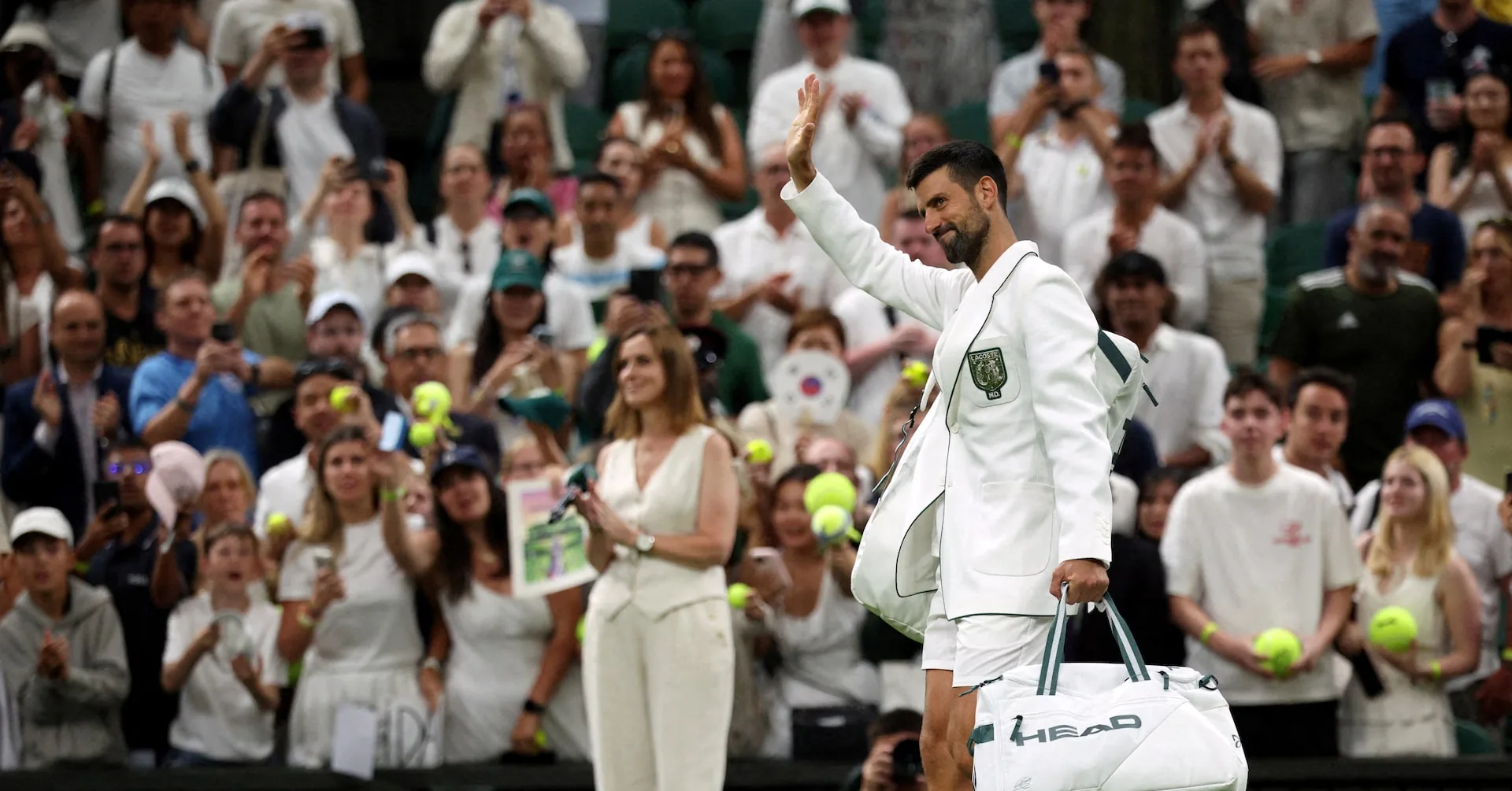
It is not just Naomi Osaka and her “Kill Bill” walk-on kimono that have turned heads at Wimbledon. Novak Djokovic and Taylor Fritz’s attire has also caught the eye as the male players and their sponsors seize their moment.
Djokovic has been coming onto court in a personalised Lacoste blazer and shorts, while Fritz wears a white cotton Hugo Boss jacket, long trousers and a white silk scarf.
“This is the first tournament where the guys are really stepping it up, which is fun to see,” said Joelle Michaeloff, chief creative officer at sports brand Wilson, who sees a growing trend of male players using clothing as self-expression. “They’re seeing what’s going on right now and looking back at these iconic moments in Wimbledon history,” said Michaeloff, whose clients include Australia’s Alex de Minaur and Ukraine’s Marta Kostyuk.
Wimbledon is the only Grand Slam requiring all-white kit, limiting the colourful creations seen at the other majors. Even so, it has staged many fashion moments, including the white bodysuit created by British designer Ted Tinling in 1985 and Roger Federer’s jacket in 2007.
For sixth seed Fritz, the high-profile entrance brings its own peril. “I really like to keep it low key,” he said. “You can’t walk out with an outfit and go out in the first round. It just looks so bad.” Fortunately he has reached the third round without dropping a set — so when he rips off the trousers, joined down the sides for easy removal, and plays in his match shorts, he has kept his cool. “Boss did this whole thing. They’re my sponsor. They wanted me to do it. I thought the outfit looked good. So yeah, we were going to do it either way.”
Sponsors increasingly use Wimbledon walk-ons as a marketing opportunity. “The relationship between athlete and brand is what’s really playing out here, and that’s what’s new and shifting,” Michaeloff said. Nike and Osaka’s team shared videos and imagery of her kimono-inspired arrival before her first match, Hugo Boss promoted Fritz’s suit, and Kostyuk collaborated with Wilson on a second version of “The Marta Dress.”
Some male players are getting more involved in the design process, weighing in on fabrics, colours, necklines and fit. “Karen Khachanov, for example, wants to discuss everything,” she said of the Russian, also into the third round. “He wants to be fashionable, but he also cares about how it performs.”
The designs do not always come off. Italy’s Matteo Berrettini, once ranked as high as sixth, said his outfit was refused: “It was not white enough. There was an option, but they didn’t let me do it.”
Michaeloff likened Fritz’s and Djokovic’s outfits to Federer’s, though the trend runs back to the legends of the 1960s and 70s. “Think of Arthur Ashe, the way he dressed, the way he showed up — that’s long before the trend we’re seeing, but the momentum and the reach have changed.” Fritz agreed: “I think the women have done more with the walk-out outfits, making it into a bit of a production. It’s cool. It’s fun. We’ll see if people do more moving forward.”
Osaka has raised the fashion stakes at every major this year: a black Kevin Germanier skirt at the French Open, a layered yellow-brown and gold Nike match dress inspired by the Eiffel Tower at night, and a jellyfish-inspired walk-on outfit at the Australian Open. “Naomi Osaka’s fashion for this year would of course be considered an iconic moment in this year’s Championships,” said Eleanor Thomas, collections lead at the All England Lawn Tennis Club.